

Ground Shaking
As the most widespread earthquake hazard, ground shaking can occur anywhere in Utah and related damage can be expected with earthquakes of magnitude 5.0 and greater. Ground shaking can also cause other earthquake hazards like liquefaction and landslides. The amount of damage from ground shaking depends on the distance from an earthquake epicenter, size of the earthquake, local geologic site conditions, and the type of building.


What is Earthquake Ground Shaking?

Generalized cross-section showing a fault rupture which causes an earthquake and generates seismic waves.
Earthquakes occur when forces within the earth’s crust exceed the strength of the rock causing the rock to suddenly break (rupture) and slip along a fault. The rupture starts miles below the ground surface. As the rock breaks and slips, the energy generated is carried as seismic waves which travel outward in all directions from the initial point of rupture, or focus (see diagram). These seismic waves are reflected and refracted in the earth’s crust and at the surface, and dissipate (lose energy) with distance as they travel away from the focus.
The ground shakes or vibrates as the seismic waves cause small temporary displacements of the ground. At the surface, the ground moves vertically up and down and horizontally back and forth. Seismic waves vary in frequency (number of waves per second). High-frequency seismic waves cause rapid ground vibrations, whereas low-frequency waves cause less-rapid shaking and cause the ground to roll more like waves on the ocean. The strength and frequency of seismic waves and the length of time strong shaking lasts all affect the amount of damage caused by ground shaking. Ground shaking may also trigger soil liquefaction, landslides, and other types of ground failure, which can also cause damage.
Learn More:
How is ground shaking measured?
Although the size of an earthquake is usually reported in terms of Richter magnitude, ground-shaking forces are most commonly reported in units of acceleration as a fraction of the force (acceleration) of gravity (g). As a seismic wave passes, it temporarily displaces each particle of earth causing the particle to “accelerate” before returning to its original position. In general, the greater the acceleration or “g” force, the stronger the ground shaking and the more damaging the earthquake.
Ground accelerations are recorded with special seismographs called accelerographs (also called strong-motion instruments). From these records, the frequency and duration of seismic waves in vertical and horizontal directions can be measured. Ground shaking at a site is typically characterized by measuring the peak, or largest, horizontal ground acceleration. The horizontal motions are usually the strongest and most damaging to buildings.
Ground motions of 0.1 g (10 percent of the force of gravity) or more may cause significant damage to particularly vulnerable buildings. Such accelerations are common near the epicenter of earthquakes of Richter magnitude 5 and larger. Ground motions exceeding 0.3 g (common in earthquakes of magnitude 5.5 and larger) may cause significant damage even to well-designed buildings. As you can see in the accelerograph record below, the peak horizontal ground acceleration at Logan from the 1957 magnitude 5.7 Richmond earthquake was over 0.1 g. Many buildings in Logan experienced damage, particularly to facades, walls, and chimneys.
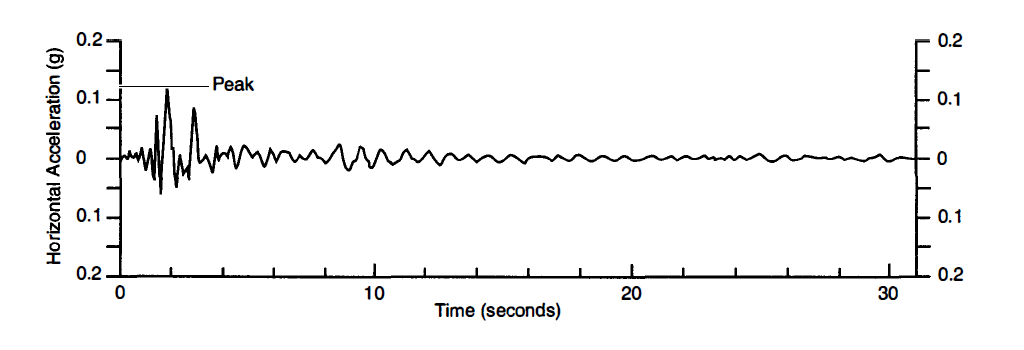
Strong-motion record from Logan from the 1962 magnitude 5.7 Richmond earthquake.
How does ground shaking affect buildings?

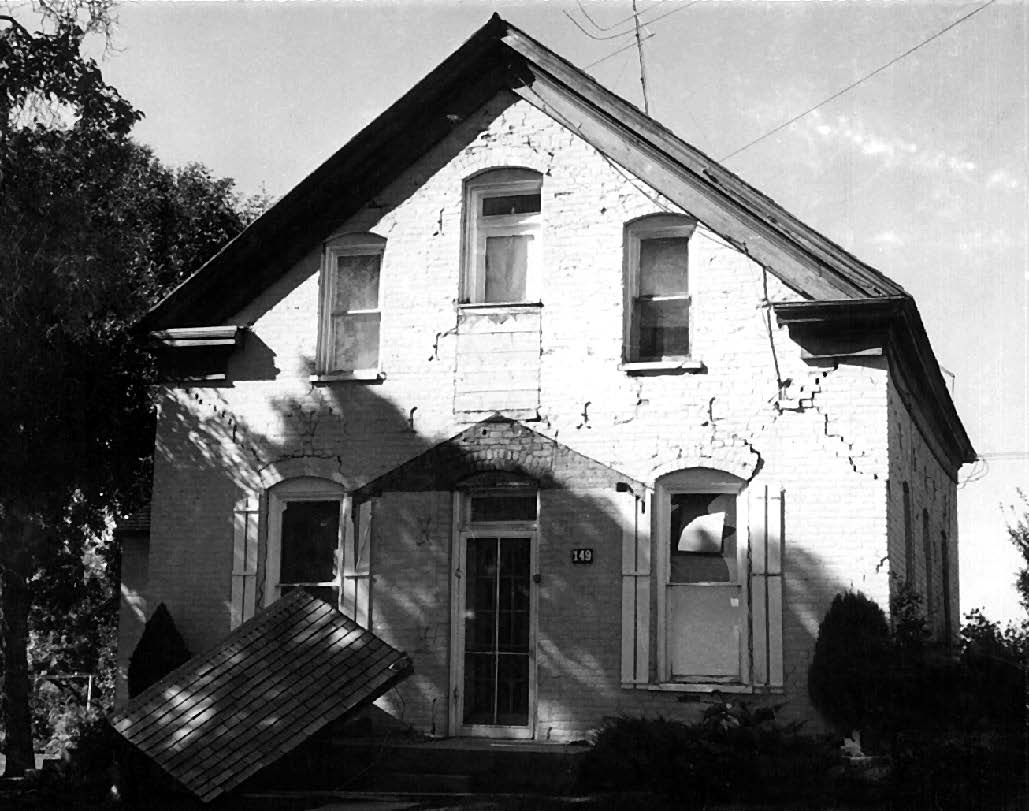
Damage to an unreinforced brick house in Richmond in the 1962 Richmond earthquake (photo by Ariel D. Ben. on, Richmond, Utah).
Damage and collapse of structures due to ground shaking is the leading cause of death and injury in earthquakes. The horizontal motion is most destructive because many structures, particularly older ones, are not built to withstand horizontal forces (except for the wind).
The frequency of seismic waves is important in determining the extent of building damage. Earthquakes commonly have a dominant frequency(s) that depends on the size of the earthquake, type of fault rupture, distance from the epicenter, and local geologic conditions. A building also has a dominant natural frequency of vibration, depending on its height and construction type, just as a tuning fork has a fixed pitch depending on the length of the prongs. If the dominant frequency of earthquake ground shaking is close to the dominant natural frequency of vibration of the building, resonance (amplification of waves) may increase damage.
Short buildings such as one- or two-story houses are most vulnerable to strong, higher frequency seismic waves. High-frequency waves are strongest near the epicenter, but rapidly dissipate as they move outward. In general, wood-frame houses sustain less damage than unreinforced brick or masonry houses.
High-rise buildings are most vulnerable to strong, long-duration, lower-frequency waves which cause the buildings to sway back and forth. Here again, unreinforced brick or masonry buildings are more vulnerable than steel-framed buildings. Low-frequency waves dissipate much slower than high-frequency waves and may cause damage at great distances from the epicenter.
Unreinforced Masonry Homes
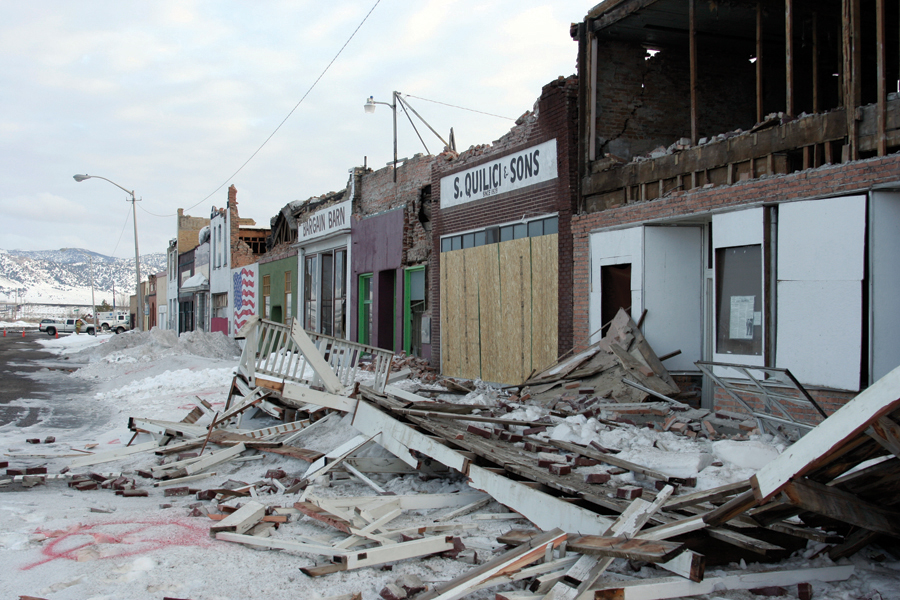
Unreinforced masonry buildings in the historic district of Wells were severely damaged in the earthquake.
One building type of particular concern in Utah is masonry constructed without steel reinforcement. Unreinforced masonry buildings were popular when the state was first settled and continued to be built into the 1970s. Bricks are created from clay which is burned in ovens at high temperatures. This material was both readily available here and familiar to the early settlers.
Many residences, in addition to commercial buildings, are unreinforced masonry buildings and were constructed without knowledge of how these structures performed in earthquakes. Unfortunately, experience now shows this is one of the most dangerous building types and evidence of its poor performance in earthquakes throughout the world is well documented.
“WE HAVE GOOD BUILDING CODES, SO WE MUST HAVE SAFE BUILDINGS.”
The best building code in the world does nothing for buildings built before the code was enacted. Although building codes used in Utah have strict seismic provisions, many older buildings, particularly unreinforced masonry buildings, have not been “retrofitted” to meet updated codes. Retrofitting—fixing problems in older buildings— is the responsibility of a building’s owner.
Do local geologic conditions affect ground shaking?
Observations in recent earthquakes indicate that certain geologic conditions, such as soft soils (particularly wet clay) and deep sediment-filled basins, amplify earthquake ground shaking above the levels found in nearby rock. The amount of amplification varies with the frequency of the seismic waves, and studies in northern Utah show that frequencies most damaging to taller buildings are greatly amplified in central basin areas on clayey soil. These studies measured waves from distant small “earthquakes” (actually, nuclear tests in Nevada), and we do not yet know how much amplification to expect during nearby, larger earthquakes.
Local amplification of ground shaking may occur along the surface projection of the fault causing the earthquake, even if the fault rupture doesn’t reach the surface. Recent studies have also shown that thin soil over shallow bedrock, such as in some Wasatch Front bench areas, amplifies the higher frequency seismic waves that are most damaging to low-rise buildings. Thus, few developed areas along the Wasatch Front will likely be free of amplified ground shaking except those built directly on rock.
Where in Utah is damaging ground shaking expected?
To determine the area of possible damaging ground shaking in Utah, we must first define the time period being considered. The longer the time period, the more likely a large earthquake producing strong ground shaking will occur. Under the Uniform Building Code, buildings must be designed to avoid collapse when subjected to a level of ground shaking that may be exceeded once in a 475-year period. This corresponds to the ground shaking level that has a one in ten chance of being exceeded in 50 years. The greatest hazard is along the Wasatch Front where large earthquakes are expected most often. The hazard is significantly less in both eastern and western Utah.
How are Utah citizens protected from ground shaking damage?
Modern buildings must conform to earthquake-resistant standards outlined in the Uniform Building Code (UBC). These standards vary depending on the earthquake hazard. The UBC was adopted by the state in 1987, but was already in use prior to 1987 in many of the more populous communities. However, earlier versions of the UBC had lower seismic zones in Utah and less strict seismic requirements. Prior to 1961, no seismic provisions were included. Thus, there is a wide range of seismic resistance in buildings in Utah, and in general, the older the building the more vulnerable it probably is to earthquakes. Also, because UBC requirements are not based on ground shaking levels expected in infrequent, large earthquakes, ground shaking in a magnitude 7.0+ earthquake would likely exceed design levels even for the highest requirements in the current UBC.