
Paradox Basin DOE Class II Study
Increased oil production and reserves utilizing secondary/tertiary recovery techniques on small reservoirs in the Paradox Basin, Utah
Final Report (pdf -14MB)
Save
Save
Objectives and Project Description
The primary objective of this project is to enhance domestic petroleum production by demonstration and technology transfer of an advanced oil recovery technology in the Paradox basin, southeastern Utah. Over 400 million bbls of oil have been produced from shallow-shelf carbonate reservoirs in the Pennsylvanian Paradox Formation in the Paradox basin of Utah, Colorado, and Arizona. With the exception of the giant Greater Aneth field, 100 plus oil fields in the basin typically contain 2 to 10 million bbls of original-oil-in-place. Only 15 to 20 percent of that oil is recoverable during primary production. To date, none of these small fields have been the site of secondary/tertiary recovery techniques used in large carbonate reservoirs and are, therefore, also at high risk of premature abandonment. Most of these fields are characterized by extremely high initial production rates followed by a very short production life (primary) and hence early abandonment. At least 200 million bbls of oil is at risk of being left behind in these small fields because of inefficient recovery practices and undrained heterogeneous reservoirs.
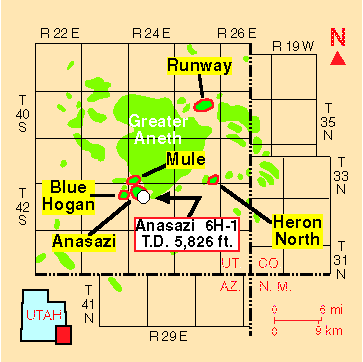
A two phase, multidisciplinary approach is being used to increase production and reserves from the shallow-shelf carbonate reservoirs in the Paradox basin. Phase I is the geological and reservoir characterization of five diversified small fields within the Navajo Nation with the best candidate field to be targeted for the pilot demonstration project.
Phase II will be a demonstration project on the field selected from the characterization study using the secondary/tertiary recovery techniques (CO2 or waterflood) identified as having the greatest potential for increased well productivity and ultimate recovery.
Project Performance Facts
The Paradox basin project consists of $2,734,501 of non-federal cost sharing, which is 54 percent of the total project cost. The project is currently within budget with approximately $4,400,000 remaining. Most project tasks are on schedule. However, the UGS has requested a no-cost extension in order to conduct an additional, second reservoir simulation which we believe will allow a more useful and complete evaluation. The project is meeting original performance expectations in this, year one of Phase I.
Participating Organizations
The following organizations are conducting work on the project: Utah Geological Survey* (prime contractor), Harken Southwest Corporation*, Utah Office of Energy and Resource Planning, Eby Petrography and Consulting Inc., and REGA Inc. (*indicates contribution to cost sharing). Data and guidance is being provided by Bligh Petroleum, Inc., Mobil Oil Corporation, and the Navajo Nation.
The Federal Government’s Engagement in this R&D
Most of shallow-shelf carbonate reservoirs are discovered and operated by small, independent oil companies that have no funds or staff to conduct R&D. Drilling budgets and operating costs are dependent on the price of oil. Small fluctuations (decreases) in oil prices can cause fields to become uneconomic and abandoned. For many operators, the cost of a secondary recovery project may be equal to a significant part of their net worth or their total investment in the fields. The technical and economic risk is too high for most operators to consider. However, if the technology can be shown to work in nearby fields, many of the operators tell us they would be eager to employ it themselves.
Federal and State governments have an economic interest in seeing increased production in these fields. Both receive direct revenues from mineral interests, royalties, and taxes. Both receive indirect benefit from increased economic activity. Although government is accepting some of the risk in this demonstration project, it will benefit proportionately more than any single operator because the cumulative return on an extra 200 million bbls of oil production will be enormous to local, state, and federal coffers. We envision this project as a prudent investment by government in maximizing return on the resources that government manages and regulates on behalf of the citizens of Utah and the U.S. Both the Federal and State governments have had an implicit partnership with oil producers since the time leases were issued or taxes levied. The DOE Oil Class Program and this project specifically, recognize that long term partnership, and seek to enhance production to mutual benefit.
Specific R&D Products/Accomplishments
The public technical and business benefits from this project will: (1) increase recoverable reserves by identifying untapped compartments created by reservoir heterogeneity, (2) increase deliverability through a waterflood or CO2 flood which exploits the reservoir along optimal fluid-flow paths, (3) identify reservoir trends for field extension drilling and stimulate exploration in Paradox basin fairways, (4) cause technology to be used in other identified basins with similar types of reservoirs, (5) prevent premature abandonment of numerous small fields, (6) reduce development costs by more closely delineating minimum field size and other parameters necessary to a successful flood, (7) allow limited energy investment dollars to be used more productively, and (8) increase royalty income to the Navajo Nation, Federal, State, and local governments, and fee owners. Through proper geological and engineering evaluation of the reservoirs, production may be increased by 175 percent (or an additional 2.1 million bbls per field) through the application of selected secondary/tertiary recovery projects.
Secondary recovery involving CO2 is very successful in the giant Greater Aneth field in the basin but differences in geology and the economics of scale have prevented operators from trying something similar on small fields. Operators are eager to try to replicate the success of the Greater Aneth field if they believe they have a reasonable chance of success. This demonstration project is intended to give them the insight to determine if they can go forward.
Expected R&D Products and Timetables
Phase I will be completed in the Fall of 1996. At that time we will determine whether the small field geology is conducive to a CO2 or waterflood and what the expected reservoir response will be. Initial results of Phase II, the field demonstration, will start by early 1997 and give a good indication of practicality of secondary recovery on small reservoirs. By the end of 1997, adjacent operators will be able to determine whether they should initiate projects of their own, even though longer term monitoring and evaluation will continue for an additional two years.
Contract No. DE-FC22-95BC14988
| DOE PROGRAM MANAGERS | |
|---|---|
| Rhonda P. Lindsey, Project Manager U.S. Department of Energy National Petroleum Technology Office P.O. Box 3628 Tulsa, OK 74101 918/699-2037 918/699-2005 (Fax) |
Viola Schatzinger, Senior Geologist BDM-Oklahoma, Inc. 220 N. Virginia Bartlesville, OK 74003 918/337-4341 (Direct line) 918/336-2400 (Main number) 918/337-4365 (Fax) |
| PROJECT ADVISORS | |
| John Johnson, Geologist Navajo Nation Minerals Department P.O. Box 1910 Window Rock, AZ 86515 520/871-6587 520/871-7095 (Fax) |
|
| PROJECT PARTICIPANTS | |
| EBY PETROGRAPHIC David E. Eby, President Eby Petrography & Consulting, Inc. 1780 E. Geddes Circle S. Littleton, CO 80122-1431 303/738-9697 (Fax capable) HARKEN ENERGY CORPORATION Bruce N. Huff David Gibbs MAILING ADDRESS FOR HARKEN ENERGY: OFFICE OF ENERGY MAILING ADDRESS FOR OFFICE OF ENERGY: |
REGA INC. 5847 San Felipe, Suite 2030 Houston, TX 77057 W.E. Culham, President/CEO Douglas M. Lorenz, Geologist UTAH GEOLOGICAL SURVEY Thomas C. Chidsey UTAH GEOLOGICAL SURVEY MAILING ADDRESS: |
2003
Culham, W.E., and Lorenz, D.M., 2003, Reservoir modeling and compositional simulation of primary depletion, water flooding, and carbon dioxide flooding of a small Pennsylvanian carbonate mound complex, Anasazi field, Paradox Basin, Utah: Utah Geological Survey Open-file Report 420, 520 p.
Culham, W.E., and Lorenz, D.M., 2003, Reservoir modeling and compositional simulation of primary depletion, water flooding, and carbon dioxide flooding of a small Pennsylvanian carbonate mound complex, Runway field, Paradox Basin, Utah: Utah Geological Survey Open-file Report 421, 420 p.
1999
Chidsey, T.C., Jr., and Eby, D.E., 1999, Diagenetic characterization of shallow-shelf carbonate reservoirs, Pennsylvanian Paradox Formation, southern Paradox basin, Utah [abs.]: American Association of Petroleum Geologists Bulletin Annual Convention,Official Program with Abstracts, v. 8, p. A24.
Chidsey, T.C., Jr., and Eby, D.E., 1999, Mule field in the Paradox basin of southeastern Utah – a case study for small carbonate buildups, horizontal drilling, and carbon dioxide flooding [abs.]: American Association of Petroleum Geologists Bulletin, v. 83, no. 7, p. 1180-1181.
Eby, D.E., 1999, Upper Devonian carbonate buildups impersonating Paradox basin phylloid algal mounds: SEPM (Society for Sedimentary Geology) Newsletter, v. 24, no. 4, p. 1 and 3.
Eby, D.E., 1999, Upper Devonian carbonate buildups impersonating Paradox basin phylloid algal mounds [abs.]: 11th Bathurst Meeting, Cambridge, UK, Journal of Conference Abstracts v. 4, no. 2, p. 915.
Montgomery, S.L., Chidsey, T.C., Jr., Eby, D.E., Lorenz, D.M., and Culham, W.E., 1999, Pennsylvanian carbonate buildups, Paradox basin – increasing reserves in heterogeneous, shallow-shelf reservoirs: American Association of Petroleum Geologists Bulletin, v. 83, no. 2, p. 193-210.
Montgomery, S.L., Chidsey, T.C., Jr., Eby, D.E., Lorenz, D.M., and Culham, W.E., 1999, Paradox study shows big oil potential with CO2: Oil & Gas Journal, v. 97, no. 18, p. 128-134.
1998
Chidsey, T.C., Jr., 1998, Paradox basin project yields successful horizontal well: Utah Geological Survey, Survey Notes, v. 31, no. 1, p. 3-4.
Chidsey, T.C., Jr., and Allison, M.L., 1998, Increased oil production and reserves utilizing secondary/tertiary recovery techniques on small reservoirs in the Paradox basin, Utah – annual report for the period February 9, 1997 to February 8, 1998: U.S. Department of Energy, DOE/BC/14988-10, 65 p.
Lorenz, D.M., Culham, W.E., Chidsey, T.C., Jr., Hartmann, Kris, 1998, Reservoir characterization of a heterolithic carbonate mound, Runway field, Paradox basin, Utah [abs.]: American Association of Petroleum Geologists Annual Convention Extended Abstracts, v. II, p. A-415.
Montgomery, S.L., 1998, Pennsylvanian carbonate buildups, southern Paradox basin – new opportunities for increased reserves: Petroleum Frontiers, v. 15, no. 4, 76 p.
Utah Geological Survey, 1998, Paradox project completes horizontal drilling, delineates potential calcarenite trend: Utah Geological Survey, Petroleum News (January), p. 10-14.
1997
Chidsey, T.C., Jr., 1997, compiler, Increased oil production and reserves utilizing secondary/ tertiary recovery techniques on small reservoirs in the Paradox basin, Utah – annual report: U.S. Department of Energy, DOE/BC/14988-9, 65 p.
Chidsey, T.C., Jr., and Eby, D.E., 1997, Heron North field, Navajo Nation, San Juan County, Utah – a case study for small calcarenite carbonate buildups [abs]: American Association of Petroleum Geologists Bulletin, v. 81, no. 7, p. 1220.
Harty, K.M., 1997, Harken is first contributor to the UGS Sample Library trust fund: Utah Geological Survey, Survey Notes, v. 29, no. 2, p. 5.
Lorenz, D.M., Culham, W.E., Chidsey, T.C., Jr., and Hartmann, Kris, 1997, Reservoir modeling of the Anasazi carbonate mound, Paradox basin, Utah [abs.]: American Association of Petroleum Geologists Annual Convention, Official Program, v. 6, p. A71-72.
Utah Geological Survey, 1997, Paradox basin minerals symposium heralded as a great success: Utah Geological Survey, Survey Notes, v. 29, no. 3, p. 8-9.
Utah Geological Survey, 1997, Oil demonstration programs move into advanced phases: Utah Geological Survey, Survey Notes, v. 30, no. 1, p. 10-11.
Utah Geological Survey, 1997, Paradox project moves to horizontal drilling: Utah Geological Survey, Petroleum News (April), p. 11-15.
U.S. Department of Energy, 1997, Increased oil production and reserves utilizing secondary/tertiary recovery techniques on small reservoirs in the Paradox basin, Utah, in Contracts for field projects and supporting research on enhanced oil recovery, reporting period January-March 1996: Progress Review No. 86, DOE/BC–96/2, p. 93-97.
U.S. Department of Energy, 1997, Increased oil production and reserves utilizing secondary/tertiary recovery techniques on small reservoirs in the Paradox basin, Utah, in Contracts for field projects and supporting research on enhanced oil recovery, reporting period April-June 1996: Progress Review No. 87, DOE/BC–96/3, p. 64-68.
U.S. Department of Energy, 1997, Increased oil production and reserves utilizing secondary/tertiary recovery techniques on small reservoirs in the Paradox basin, Utah, in Contracts for field projects and supporting research on enhanced oil recovery, reporting period July-September 1996: Progress Review No. 88, DOE/BC–96/4, p. 79-83.
Chidsey, T.C., Jr., compiler, 1997, Increased oil production and reserves utilizing secondary/tertiary recovery techniques on small reservoirs in the Paradox basin, Utah – annual report: U.S. Department of Energy, DOE/BC/14988-8, 117 p.
1996
Bon, R.L., 1996, Paradox basin project set to blast off: Utah Geological Survey, Survey Notes, v. 28, no. 2, p. 12.
Chidsey, T.C., Jr., Brinton, Lisë, and Eby, D.E., 1996, Carbonate mound reservoirs in the Paradox Formation – an outcrop analogue along the San Juan River, southeastern Utah, in Huffman, A.C., Jr., Lund, W.R., and Godwin, L.H., editors, Geology and resources of the Paradox basin: Utah Geological Association Publication 25, p. 139-156.
Chidsey, T.C., Jr., and Eby, D.E.., 1996, Geological and reservoir characterization of shallow-shelf carbonate fields, southern Paradox basin, Utah [abs]: American Association of Petroleum Geologists Bulletin Annual Convention, Program with Abstracts, p. A10.
Chidsey, T.C., Jr., Eby, D.E., Groen, W.G., Hartmann, Kris, and Watson, M.C., 1996, Anasazi, in Hill, B.G., and Bereskin, S.R., editors, Oil and gas fields of Utah: Utah Geological Association 22 (Addendum), non-paginated.
___, 1996, Blue Hogan, in Hill, B.G., and Bereskin, S.R., editors, Oil and gas fields of Utah: Utah Geological Association 22 (Addendum), non-paginated.
___, 1996, Heron North, in Hill, B.G., and Bereskin, S.R., editors, Oil and gas fields of Utah: Utah Geological Association 22 (Addendum), non-paginated.
___, 1996, Mule, in Hill, B.G., and Bereskin, S.R., editors, Oil and gas fields of Utah: Utah Geological Association 22 (Addendum), non-paginated.
___, 1996, Runway, in Hill, B.G., and Bereskin, S.R., editors, Oil and gas fields of Utah: Utah Geological Association 22 (Addendum), non-paginated.
Chidsey, T.C., Jr., Eby, D.E., and Lorenz, D.M., 1996, Geological and reservoir characterization of small shallow-shelf fields, southern Paradox basin, Utah, in Huffman, A.C., Jr., Lund, W.R., and Godwin, L.H., editors, Geology and resources of the Paradox basin: Utah Geological Association Publication 25, p. 39-56.
Chidsey, T.C., Jr., Morgan, C.D., Eby, D.E., Brinton, Lisë, and Hartmann, Kris, 1996, Carbonate mound reservoirs in the Paradox Formation – an outcrop analogue along the San Juan River, southeastern Utah [abs]: American Association of Petroleum Geologists Bulletin, v. 80, no. 6, p. 968.
Doelling, H.H,. and Willis, G.C., 1996, Utah Geological Association 1996 Fall field trip road and river log, in Huffman, A.C., Jr., Lund, W.R., and Godwin, L.H., editors, Geology and resources of the Paradox basin: Utah Geological Association Publication 25, p. 405-460.
Utah Geological Survey, 1996, Paradox project in final stage of reservoir characterization: Utah Geological Survey, Petroleum News (May), p. 14-17.
U.S. Department of Energy, 1996, Increased oil production and reserves utilizing secondary/tertiary recovery techniques on small reservoirs in the Paradox basin, Utah, in Contracts for field projects and supporting research on enhanced oil recovery, reporting period January-March 1995: Progress Review No. 82, DOE/BC–95/2, p. 145-147.
U.S. Department of Energy, 1996, Increased oil production and reserves utilizing secondary/tertiary recovery techniques on small reservoirs in the Paradox basin, Utah, in Contracts for field projects and supporting research on enhanced oil recovery, reporting period April-June 1995: Progress Review No. 83, DOE/BC–95/3, p. 85-87.
U.S. Department of Energy, 1996, Increased oil production and reserves utilizing secondary/tertiary recovery techniques on small reservoirs in the Paradox basin, Utah, in Contracts for field projects and supporting research on enhanced oil recovery, reporting period July-September 1995: Progress Review No. 84, DOE/BC–95/4, p. 95-100.
U.S. Department of Energy, 1996, Increased oil production and reserves utilizing secondary/tertiary recovery techniques on small reservoirs in the Paradox basin, Utah, in Contracts for field projects and supporting research on enhanced oil recovery, reporting period October-December 1995: Progress Review No. 85, DOE/BC–96/1, p. 98-103.
Contact
For more information on the Paradox Basin Project, contact Tom Chidsey, (801) 537-3364, email: tomchidsey@utah.gov.
Save
Save


