

Bluebell Field DOE Class I Study
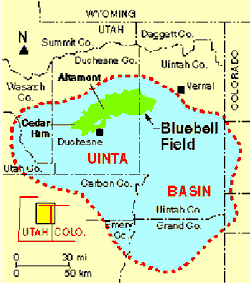
Bluebell Field Map
The Bluebell field study entitled “Increased oil production and reserves from improved completion techniques in the Bluebell field, Uinta Basin, Utah” is a five year project
funded inpart by the U.S. Department of Energy under their Near Term, Class I, Field Demonstration in Fluvial Dominated Deltaic Reservoirs, oil program.
Public abstract from the proposal submitted
to the U.S. Department of Energy in January 1992.
VOLUME II – DEMONSTRATION PROJECT
Over 378 million bbls of oil has been produced from sandstones deposited in fluvial- dominated deltas in the Paleocene/Eocene Green River and Wasatch Formations in the Uinta Basin, Utah. Production is from an oil-bearing section up to 8,000 feet thick, of which 2,500 feet is overpressured. The Bluebell field is the largest field in the Uinta Basin having produced over 118 million barrels of oil from 213 active wells. However, examination of mud log shows, geophysical logs, and reservoir data indicate that generally less than 25% of the perforated and potentially productive zones contribute oil and gas to the wellbores. Well spacing is 320 acres and 640 acres in many areas of the field. The risk of abandonment is high due to the decline in production rates and increasing water cut from many of the older wells. Approximately 25% of the wells have been abandoned already. At least 1 billion bbls of mobile oil is at risk of being left behind in the Uinta Basin because of inefficient completion practices and undrained heterogeneous reservoirs.
Geologic characterization of the Green River-Wasatch formations is generally on a basin wide scale, and does not address individual facies within the Bluebell field. Lacking detailed knowledge of individual reservoirs, completion practices used over the past 30 years continue to be applied to large gross intervals in a “hit or miss” fashion. Thus there is the potential for vast increases in production and reserves by improving completion techniques in the Uinta Basin.
A three phase, multidisciplinary approach will used to increase production and reserves in the Bluebell field. Phase 1 will be the geological and reservoir characterization of the Green River and Wasatch Formations. This will include: a) log analysis and petrophysics evaluation, b) examination of outcrops, well cuttings and cores in order to understand microfacies heterogeneity and reservoir capacity, c) detailed correlation of geophysical logs and construction of various subsurface maps to define lithofacies, fracture trends, and paleodepositional setting of primary producing horizons, d) determine the location of fractures throughout the producing section, their orientation, nature and relation to lithology or facies, e) statistical analysis of the completion techniques and production histories of wells in the field to identify those practices which are most economical and result in the most productive wells, f) determination of in-place and mobile reserves as well as increased mobile reserves resulting from the demonstration project.
Phase 2 will be a demonstration project testing zones and areas recommended from the geological characterization using completion techniques identified as having the greatest potential for increased well productivity. The demonstration project will include a) recompletion of a well that suffered formation damage during drilling operations, b) a redrill of a portion of a well that suffered formation damage during the original completion, c) the drilling and completion of a new well to show that careful geological and engineering can correctly lead to improved production and increased reserves.
Phase 3 will be evaluation of the demonstration projects and technical transfer of the geologic and reservoir characterization and the results of the demonstration project. The multidisciplinary consortium approach, composed of operators, service companies, consultants, academics, and state agencies, is inherently built into the project to improve the technical transfer phase. Technical transfer activities include a) a petroleum extension service, b) workshops, seminars in Salt Lake, Vernal, Denver, and Houston, c) publications and technical presentations, d) the creation of digital databases, and e) addressing regulatory, economic, and financial needs.
January 22, 1996, Submitted By Craig D. Morgan
Contact
For more information on the Bluebell Project, contact Craig Morgan, (801) 537-3370 or email: craigmorgan@utah.gov