
CCUS Project
Reactive, Multi-phase Behavior of CO2 in Saline Aquifers beneath the Colorado Plateau
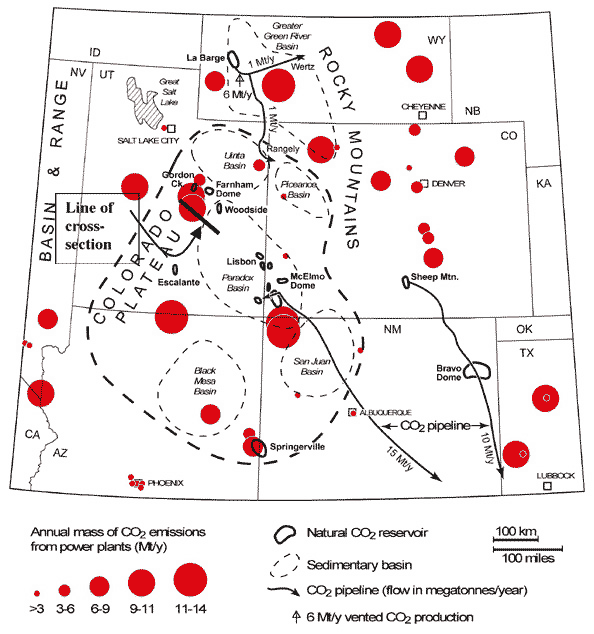
Major occurrences of known gas fields having high concentrations of CO2. Red dots are the point sources of CO2 emissions from power plants with dots sized according to the amount of annual CO2 emissions (in million metric tons).
The Department of Energy’s National Energy Technology Laboratory (NETL) funded a project titled “Reactive, Multi-phase Behavior of CO2 in Saline Aquifers beneath the Colorado Plateau” for a three-year period beginning August 13, 2000.
This project involves three research organizations: the Utah Geological Survey (UGS), the Energy and Geoscience Institute at the University of Utah (EGI), and Industrial Research Limited from New Zealand (IRL). The Principal Investigators are Rick Allis (UGS), Joe Moore (EGI) and Stephen White (IRL).
In addition to the funding from NETL, more funding is being contributed by the UGS and the Utah Energy Office. Total funding for this project is $428,000.
Research Initiatives
Carbon sequestration is a priority research area of the Department of Energy’s National Energy Technology Laboratory (NETL), and involves the following programs:
- Carbon Capture (developing technologies to extract CO2 from power plant flue gases and industrial point source emissions)
- Geologic Sequestration (long-term storage of CO2 underground)
- Ocean Sequestration (long-term storage of CO2 deep within the ocean)
- Terrestrial Sequestration (the net removal of CO2 from the atmosphere or the prevention of CO2 net emissions from the terrestrial ecosystems into the atmosphere)
- Advanced Projects (developing technologies to recycle or reuse CO2 from energy systems)
The Utah Geological Survey, Energy and Geoscience Institute, and Industrial Research Limited (UGS-EGI-IRL) project is part of the Geologic Sequestration program. For more information on NETL’s carbon sequestration programs go to http://www.fe.doe.gov/programs/sequestration
In 2002, the President announced a “Global Climate Change Initiative” goal of reducing the nation’s greenhouse gas intensity by 18% between 2002 and 2012. The greenhouse gas intensity is the ratio of total annual greenhouse gas emissions (mostly carbon dioxide [CO2], plus methane, nitrous oxide and other gases) divided by the gross domestic product. This ratio is considered to be an indicator of the reduction in gas emissions that can occur without affecting economic growth.
The underlying philosophy is that stimulating and applying the technologies required for stabilizing and ultimately reducing greenhouse gas concentrations is best achieved by sustained economic growth. Between 1990 and 2000 the U.S. reduced its greenhouse gas intensity by 12%, so the target for the next decade is a challenging one.
In early 2003, DOE circulated a “Regional Carbon Sequestration Partnership” solicitation to stimulate a government/industry effort to create a nationwide network of partnerships to determine the most suitable technologies, regulations, and infrastructure needs for carbon capture, storage and sequestration in different areas of the country. DOE has set aside $8 – 10 million for this initiative. For details, see:http://www.netl.doe.gov/coalpower/sequestration/partnerships/index.html
Several Utah agencies have agreed to join up with similar agencies in surrounding states in a proposal to form a partnership centered on the southwest U.S. The states include New Mexico, Arizona, Utah, Colorado, Oklahoma, southern Wyoming and northern Texas and also include the Navajo Nation (see map).
The UGS is coordinating Utah’s involvement, which if funded, will also involve participants from the Utah Automated Geographic Reference Center, the University of Utah and EGI, Utah State University, Division of Air Quality (DEQ), Utah Energy Office (DNR), and the Division of Oil Gas and Mining (DNR). Pacificorp and the Intermountain Power Agency have agreed to be industry partners.
If the Southwest Partnership Region proposal is funded, information about the scope of the project and progress will be posted on this website. A funding announcement is expected from DOE during the second half of 2003.
Abstract
The Colorado Plateau and adjacent Rocky Mountain region contain over 10,000 MW of coal-fired electricity emitting close to 100 million tonnes (Mt) of CO2 each year. This region also contains numerous natural CO2 fields in deep saline aquifers that are analogues for repositories of CO2 separated from flue gases of power plants. Several of these CO2 fields are presently in production, with most CO2 (25 Mt/year) being piped 800 km to enhanced oil recovery projects in west Texas.
The principal research goals are:
- Identification of the geochemical reactions that will be critical for CO2sequestration in potential reservoirs of the Colorado Plateau;
- Quantification of the volume of CO2 that can be stored within typical reservoir geometries, and the factors controlling the volume;
- Evaluation of the consequences of permeability changes for well injectivity and CO2 containment as a result of CO2 sequestration;
- Investigation of the effects of hydrodynamic factors typical of saline aquifers of the Colorado Plateau on CO2 containment, including leakage to near-surface aquifers and the role of faulting;
- Assessment of the ultimate fate of injected CO2 and its distribution between a gas phase, dissolved CO2 and locally fixed CO2 (i.e. as carbonate) for typical representative reservoir and fluid geochemistry;
- Identification of environmental risks associated with CO2 leakage from repositories;
- Re-evaluation of the published CO2 reserve estimates for known CO2reservoirs on the Colorado Plateau, the extent of depletion through CO2production, and an estimate of the total storage possible if CO2 injection were to occur;
- Evaluation of the effect of other flue gas constituents, especially those containing sulfur.
Core from reservoir and seal rocks of several CO2 fields around the Colorado Plateau will be studied using petrographic and fluid-inclusion techniques to identify the alteration characteristics of late-stage CO2 flooding. This will be combined with a review of the physical and chemical information on the natural state of the fluid regimes, and will provide constraints for numerical simulation of the process of injecting large volumes of CO2 into such reservoirs.
The simulator CHEM-TOUGH2 will be used because of its ability to handle non-isothermal, multiphase reactive transport with full coupling between reactive chemistry and transport. Model scenarios will involve varying lithology and water chemistry, tight and leaky seal rocks, and hydrologic gradients at both reservoir depths and in the overlying unconfined groundwater zone.
Results will be compared with the characteristics of known CO2 reservoirs around the Colorado Plateau, allowing recommendations on their suitability for sequestration of separated CO2 flue gas. A cost-share component will be underwritten by the Energy and Geoscience Institute (University of Utah) Petroleum Exploration Corporate Associates research funds.
Project Overview
This project investigates the probable fate of CO2 if it can be economically separated from power plant flue gases and injected beneath the Colorado Plateau. A critical issue is how long it will remain trapped in the subsurface. Effective sequestration requires a time scale of about 1000 years without significant leakage back to the surface.
The Colorado Plateau has several factors that make it attractive as a possible sequestration region. It has broad, relatively simple, geologic structures with proven reservoir-seal rock layers and potentially large storage capacity; many nearby large coal-fired power plants represent major point sources of CO2 emissions suitable for capture and separation; and natural CO2fields that prove it is possible to store the gas in the subsurface on a geological time scale (see adjacent map; Mt/y is the flux of CO2 in units of million tons per year).
It also contains two pipeline networks that transport CO2 from several of these natural fields to enhanced oil recovery projects in southern Wyoming, western Colorado, and west Texas. Power plants in the region presently emit over 100 million tons per year of CO2 to the atmosphere, and there is an additional 30 million tons per year of production from the natural CO2 fields.
The Utah Geological Survey, Energy and Geoscience Institute, and Industrial Research Limited (UGS-EGI-IRL) project of the natural CO2 fields shows they are similar to conventional natural gas fields, with gas trapped in dome-like structures. The most common reservoir lithologies are sandstone and dolomite; mudstone, shale and anhydrite are the most common sealing rocks.
The horizontal dimensions of the gas reservoirs (~ 10 kilometers or 6 miles) are typically 100 times larger than the reservoir thickness. Stacked CO2 reservoirs (or occurrences) are not uncommon, indicating that gas has migrated up through the rock section.
In the CO2 fields where petrological and geochemical work on rock and fluids has been possible (some central Utah fields and Springerville field, southeast Arizona), the present-day fluids are super-saturated in dolomite and calcite. At Springerville, the influx of CO2 appears to have caused early precipitation of dawsonite (sodium-aluminum-carbonate). These CO2 fields indicate natural, long-term storage of carbon has occurred as precipitated carbonate minerals (mineral trapping) as well as by hydrodynamic trapping of gas and dissolved CO2 in the pore water.
Modeling of the fate of injected CO2 has been carried out using a computer program that considers both the two-phase behavior of CO2 and fluid-rock reactions. The models have been applied to cross-sections through typical geologic structures of central Utah, incorporating the mineralogy and physical properties of the units (for example, permeability, porosity, mineral thermodynamics, and capillary pressure functions for seal rocks) in the sedimentary sections.
An important finding of the modeling is that structural traps are not essential for sequestration of the CO2, as shown in the adjacent figure, and that all three trapping mechanisms (as solid, liquid and gas) are important.
In the example shown here, CO2 has been injected into the White Rim sandstone at about 1 kilometer depth for 30 years and at a rate equivalent to that emitted by a 500 megawatt, coal-fired power plant. Although there is a regional dip to the section and the CO2 gas tends to move up-dip (to east) as well as up-section with time, after 1000 years 70 percent of the injected CO2 remains trapped in the subsurface.
The colors show the fraction of gas in the pores (gas saturation). The modeling suggests that there is ample storage in geologic structures beneath the Colorado Plateau, but a critical factor is whether the reactions that precipitate CO2 have time to occur.
These reactions typically require time scales of hundreds of years, so subsurface trapping for at least 500 years is essential. If major, high permeability faults are present, then loss of CO2 to the surface could make the injection site unsuitable for CO2 sequestration.
Presentations
Implications of results from CO2 flux surveys over known CO2 systems for long-term monitoring
Rick Allis, Tom Chidsey, Craig Morgan, and Kevin McClure, Utah Geological Survey
Joe Moore, Energy & Geoscience Institute, Univ. of Utah
Deborah Bergfeld, U.S.G.S.
Jason Heath and Brian McPherson, New Mexico Tech.
Presented at the Fourth Annual Conference on Carbon Capture & Sequestration, Alexandria, Virginia, 2005.
Natural CO2 Reservoirs on the Colorado Plateau & Southern Rocky Mountains: Candidates for CO2 Sequestration
Rick Allis, Thomas C. Chidsey, Jr., Wally Gwynn, and Craig D. Morgan, UGS
S. White, Industrial Research Ltd
M. Adams and J. Moore, Energy and Geoscience Institute, University of Utah
Publications
CO2 sequestration potential beneath large power plants in the Colorado Plateau-Southern Rocky Mountain region, USA.
R.G. Allis, T.C. Chidsey, C. Morgan, J. Moore, S. White, Second Annual Conference on Carbon Sequestration, NETL Proceedings, May 5-8, 2003
Investigations of CO2 Mobility in Natural Reservoirs Beneath the Colorado Plateau and Southern Rocky Mountains.
J. Moore, R. Allis, S. Lutz, M. Adams, Second Annual Conference on Carbon Sequestration, NETL Proceedings, May 5-8, 2003
Injection of CO2 into an Unconfined Aquifer Located beneath the Colorado, Central Utah, USA.
S.P. White, R.G. Allis, J. Moore, T.Chidsey, C.Morgan, W. Gwynn, M.Adams. Second Annual Conference on Carbon Sequestration, NETL Proceedings, May 5-8, 2003
Natural CO2 Reservoirs on the Colorado Plateau and Southern Rocky Mountains, USA, A Numerical Model.
White, S., Allis, R., Moore , J., Chidsey, T., Morgan, C., Gwynn, W.and Adams, M., 2002. Proc. Greenhouse Gas Control Technologies 6th Conference, Kyoto, Japan Oct. 2002
Natural CO2 Reservoirs on the Colorado Plateau and Southern Rocky Mountains: Candidates for CO2 Sequestration.
Allis, R., White, S., Chidsey, T., Gwynn, W., Morgan, C., Adams, M., Moore, J., 2001., Proceedings of the First National Conference on Carbon Sequestration, Washington DC, May 2001
Contact
For more information contact Michael Vanden Berg, 801-538-5419; michaelvandenberg@utah.gov