
Recognizing and Reducing Landslide Damage on Your Property
Landslides are common in Utah. Landslide hazards are greatest near or on steep slopes or along streams. And REMEMBER – Homeowner’s insurance typically does not cover landslide damage! If you suspect imminent landslide danger, contact your local fire, police, or public works department, inform neighbors, and evacuate.
Common Landslides in Utah
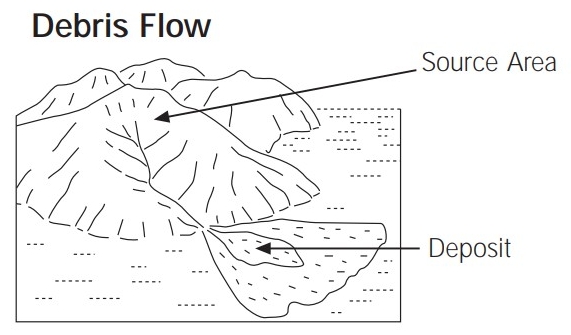
Debris flows consist of sediment-water mixtures that flow down a streambed or hillslope, commonly depositing sediment at canyon mouths.
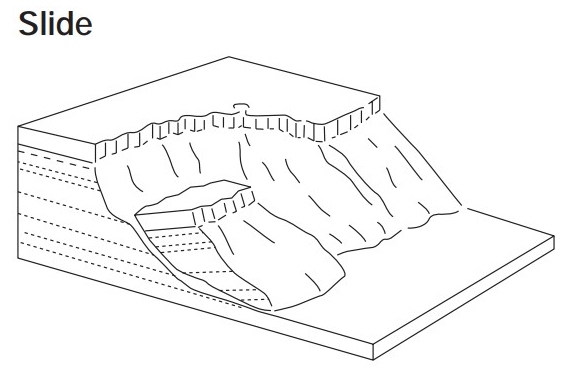
Slides are downslope movements of soil or rock on slopes.
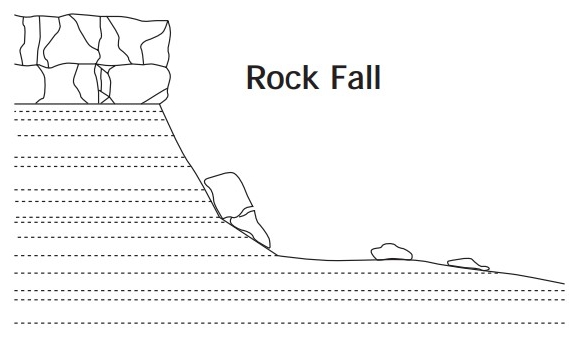
Rock falls consist of rock(s) falling from a cliff or cut slope.
Landslides commonly occur as a result of:
- Heavy rainfall.
- Rapid snowmelt.
- A wet winter and spring, particularly if previous years were also wet.
- Grading that removes material from the base, loads material at the top, or otherwise alters a slope.
- Earthquakes.
- Erosion or previous landsliding removing material from the base of a slope.
- Addition of water to a slope from agricultural or landscape irrigation, roof downspouts, poor drainage, septic-tank effluent, canal leakage, or broken water or sewer lines.
Areas that are generally prone to landslides are:
- Existing landslides.
- Steep natural slopes, particularly in weak geologic materials.
- Steep construction-related cut or fill slopes.
- Areas in or at the mouths of drainages (such as canyons).
- Slopes below leaking canals or ponds.
- Developed hillsides where septic-tank soil-absorption systems are used and landscapes are irrigated.
- Below cliffs or hills with outcrops of fractured rock.
Features that might indicate landslide movement are:
Springs, seeps, or saturated ground in previously dry areas.
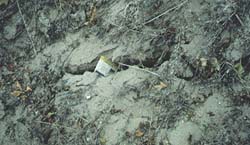
Ground crack.
Cracks in snow, ice, soil, or rock.
Soil pulling away from foundations.
Offset fence lines.

Damaged sidewalk.
Unusual bulges or elevation changes in the ground, pavements, or sidewalks.

Foundation damage.
Excessive tilting or cracking of concrete floors and foundations.
Broken water lines and other underground utilities.
Rapid increase or decrease in stream water levels, possibly accompanied by increased turbidity (soil content).
Decks and patios tilting and/or moving relative to the main house.
Tilting telephone poles, trees, retaining walls, or fences.

Door frame out of plumb.
Sticking doors and windows, and visible open spaces indicating walls and frames out of plumb.
Appearance of bare spots on slopes.
Intermittent creaking, snapping, or popping noises from a house.
Sunken or downdropped roads.
What a homeowner can do to reduce the likelihood of landslides:
- Minimize landscape irrigation – overwatering on bluff-tops is a common cause of landslides.
- Drain water from surface runoff, downspouts, and driveways well away from unstable slopes and landslides.
- Make sure water and sewer lines do not leak.
- Avoid removing material from the base of slopes or adding weight at the top.
- Contact a geotechnical consultant for professional advice.
Additional Information
For further information on landslides in your area:
- In Salt Lake County, contact the County Geologist at 468-2061.
- Contact the Utah Geological Survey at 801-537-3300.
- Contact Emergency Services and Homeland Security (previously Comprehensive Emergency Management) at 801-538-3400.
- For a detailed site analysis, contact a private consulting company specializing in earth movement. Such companies are listed in the Yellow Pages and specialize in geotechnical engineering and engineering geology. Your state or county geologist could advise you of the type of professional to contact.
References
Crudden, D.M., and Varnes, D.J., 1996, Landslide types and processes, in Turner, A.K., and Schuster,R.L., Landslides, investigation and mitigation: Washington, D.C., National Research Council, Transportation Research Board, Special Report 247, p. 36-75.
Harty, K.H., 1991, Landslide map of Utah: Utah Geological and Mineral Survey Map 133, 1:500,000, 28 p.
National Landslide Information Center, U.S. Geological Survey, Denver, Colorado
Shelton, D.C., and Prouty, Dick, 1979, Nature’s building codes, geology and construction in Colorado: Colorado Geological Survey Special Publication 12, 72 p.
Zaruba, Q., and Mencl, V., 1969, Landslides and their control: Amsterdam, Elsevier, 205 p.