
How was Utah’s topography formed?
By Mark R. Milligan
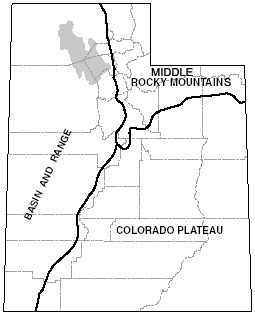
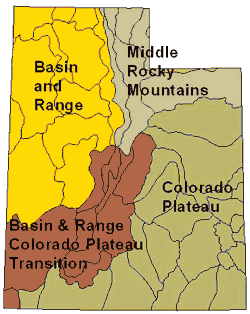
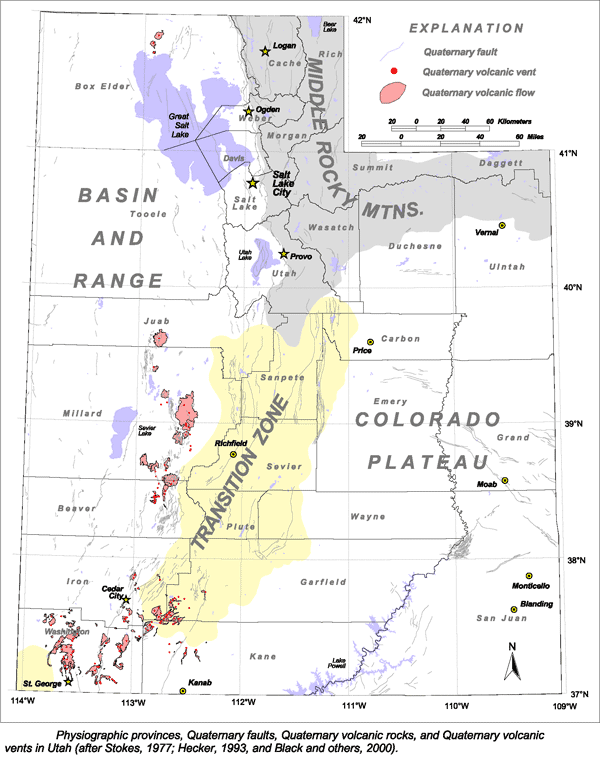
Basin and Range Province
Steep, narrow, north-trending mountain ranges separated by wide, flat, sediment-filled valleys characterize the topography of the Basin and Range Province. The ranges started taking shape when the previously deformed Precambrian (over 570 million years old) and Paleozoic (570 to 240 million years old) rocks were slowly uplifted and broken into huge fault blocks by extensional stresses that continue to stretch the earth’s crust.
Sediments shed from the ranges are slowly filling the intervening wide, flat basins. Many of the basins have been further modified by shorelines and sediments of lakes that intermittently cover the valley floors. The most notable of these was Lake Bonneville, which reached its deepest level about 15,000 years ago when it flooded basins across western Utah.
Colorado Plateau Province
In contrast with the Basin and Range Province, a thick se- quence of largely undeformed, nearly flat-lying sedimentary rocks characterize the Colorado Plateau province. Erosion sculpts the flat-lying layers into picturesque buttes, mesas, and deep, narrow canyons.
For hundreds of millions of years sediments have intermittently accumulated in and around seas, rivers, swamps, and deserts that once covered parts of what is now the Colorado Plateau. Starting about 10 million years ago the entire Colorado Plateau slowly but persistently began to rise, in places reaching elevations of more than 10,000 feet (3,000 meters) above sea level. Miraculously it did so with very little deformation of its rock layers. With uplift, the erosive power of water took over to sculpt the buttes, mesas, and deep canyons that expose and dissect this “layer cake” of sedimentary rock.
Of course, exceptions to this layercake geology do exist. For example, igneous rocks that cooled from oncerising magma form the core of the Henry, La Sal, and Abajo Mountains, and several wrinkles or folds, such as the San Rafael Swell and Waterpocket Fold, can also be found as exceptions to the rule of flat-lying beds.
Middle Rocky Mountains Province
High mountains carved by streams and glaciers characterize the topography of the Middle Rocky Mountains province. The Utah portion of this province includes two major mountain ranges, the north-south-trending Wasatch and east-west-trending Uintas. Both ranges have cores of very old Precambrian rocks, some over 2.6 billion years old, that have been altered by multiple cycles of mountain building and burial.
Uplift of the modern Wasatch Range only began within the past 12 to 17 million years. However, during the Cretaceous Period (138 to 66 million years ago), compressional forces in the earth’s crust began to form mountains by stacking or thrusting up large sheets of rock in an area that included what is now the northeasternmost part of Utah, including the northern Wasatch Range. This thrust belt was then heavily eroded. About 38 to 24 million years ago large bodies of magma intruded parts of what is now the Wasatch Range. These granitic intrusions, eroded thrust sheets, and the older sedimentary rocks form the uplifted Wasatch Range as it is seen today.
The Uinta Mountains were first uplifted approximately 60 to 65 million years ago when compressional forces created a buckle in the earth’s crust, called an anticline. The mountains formed by this east-west-trending anticline were subsequently eroded back down, but began to rise again about 15 million years ago to their present elevations of over 13,000 feet above sea level.
The Middle Rocky Mountains province is further characterized by sharp ridge lines, U-shaped valleys, glacial lakes, and piles of debris (called moraines) created during the Pleistocene (within the last 1.6 million years) by mountain glaciers.
This is, of course, a most cursory overview of the geologic events that formed the topography of Utah’s three physiographic provinces. Numerous anomalies and variations give color and detail to the big picture outlined here.
Basin and Range – Colorado Plateau Transition Zone
The Basin and Range-Colorado Plateau transition zone is a broad region in central Utah containing structural and stratigraphic characteristics of both the Basin and Range Province to the west and the Colorado Plateau province to the east.
The boundaries are the subject of some disagreement, resulting in various interpretations using different criteria.
Essentially, extensional tectonics of the Basin and Range has been superimposed upon the adjacent coeval uplifted blocks of the Colorado Plateau and Middle Rocky Mountains.
The result is that block faulting, the principal feature of the Basin and Range, extends tens of kilometers into the adjacent provinces forming a 100-km- (62 mi) wide zone of transitional tectonics, structure, and physiography.
Survey Notes, v. 32 no. 1, January 2000
