

GeoSights: Bentonite Hills
by Stephanie Carney and Jackson Smith
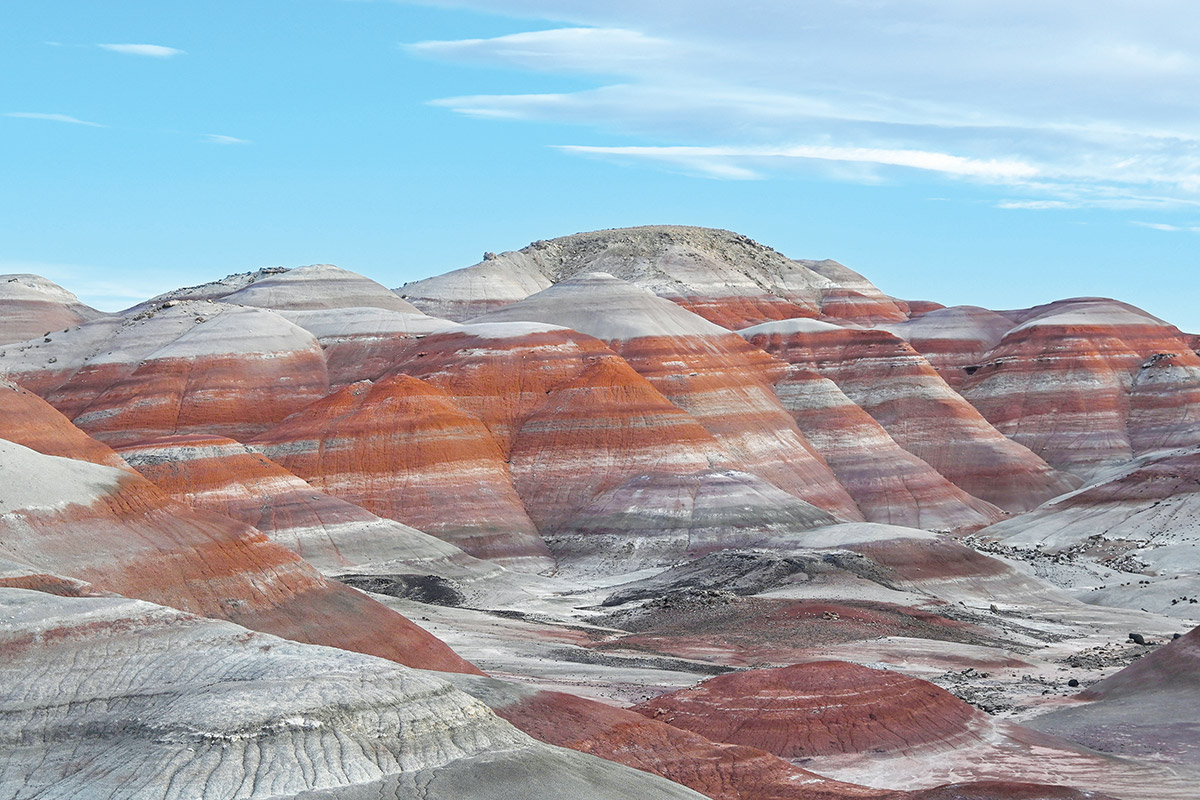
View to the north of variegated slopes of the Brushy Basin Member of the Jurassic-age Morrison Formation in the Bentonite Hills.
With so many interesting and scenic places in Utah, it is hard to choose where to plan your next adventure. But if you are looking for spectacular geology somewhere off the beaten path, consider a visit to Bentonite Hills. Located just outside the northeastern boundary of Capital Reef National Monument on public land, this quiet, remote area in central Utah is a fantastically barren landscape of rounded, rolling hills with variegated reddish-brown-, green-, gray-, and yellow-colored layers. These slopes and hills are composed of sedimentary strata of the Brushy Basin Member of the Late Jurassic-age Morrison Formation and sporadically capped by the Early Cretaceous-age Cedar Mountain Formation.
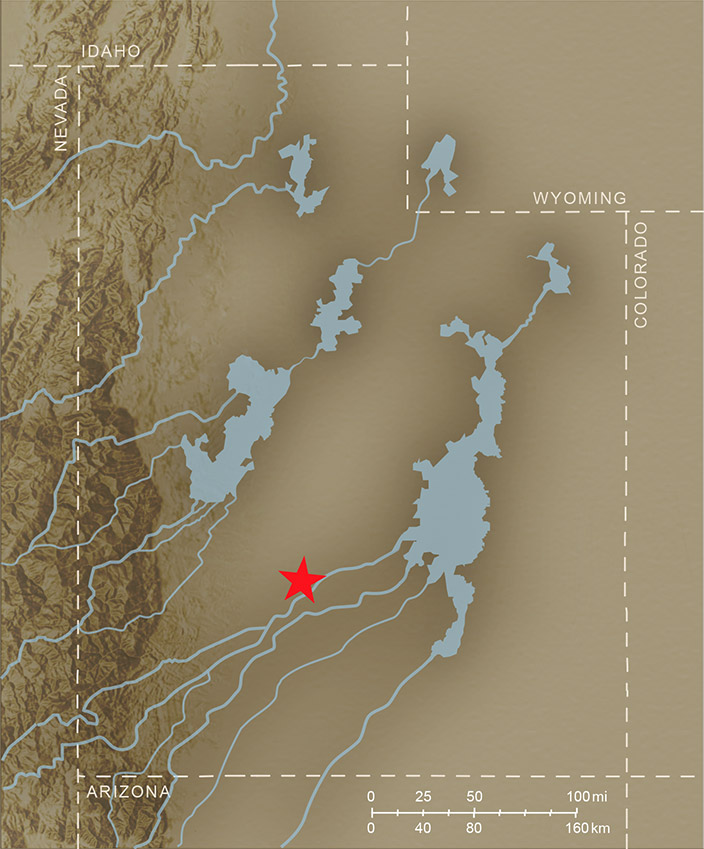
Paleogeographic map of Utah during the Late Jurassic.
The Morrison Formation was deposited during the Late Jurassic between about 157 and 150 million years ago and is famous for containing over 30 genera of dinosaur fossils. At the time of deposition, the Farrallon tectonic plate was subducting beneath the western edge of North America, creating a broad area of volcanoes and highlands west and southwest of Utah. Most of the sediment that would become the Morrison Formation was transported and deposited by large rivers and streams draining east and northeastward from these highlands. These rivers deposited sediments over a vast alluvial plain that extended from northern Arizona and New Mexico northward to southern Canada and eastward to central Nebraska, South Dakota, and North Dakota. These sediments also include a complex mosaic of deposits from lakes, wetlands, floodplains, and swamps that dotted the region, and copious amounts of ash from volcanic eruptions accumulated over the region. During the Late Jurassic, the climate in this area is thought to have been semi-arid.
The Morrison Formation is divided into three members in the Capitol Reef and Bentonite Hills area (from oldest to youngest): the Tidwell, Salt Wash, and Brushy Basin Members. The Tidwell and Salt Wash Members are generally light gray and brown sandstone and conglomerate, whereas the Brushy Basin Member is mostly siltstone and mudstone, with some lenses of sandstone and limestone. During deposition of the Brushy Basin, volcanic eruptions would periodically inundate the river systems with ash leaving broad areas of floodplain deposits composed of fine-grained silt, mud, and ash. After deposition and burial, the feldspar and silica minerals in the ash were chemically altered to smectite clay minerals, also known as “swelling clays.” Bentonite, which consists mostly of the smectite clay montmorillonite, swells when wet and then dries to a bumpy, crusty texture. Cyclical wetting and drying creates this “popcorn” weathering across exposures of the Brushy Basin Member.
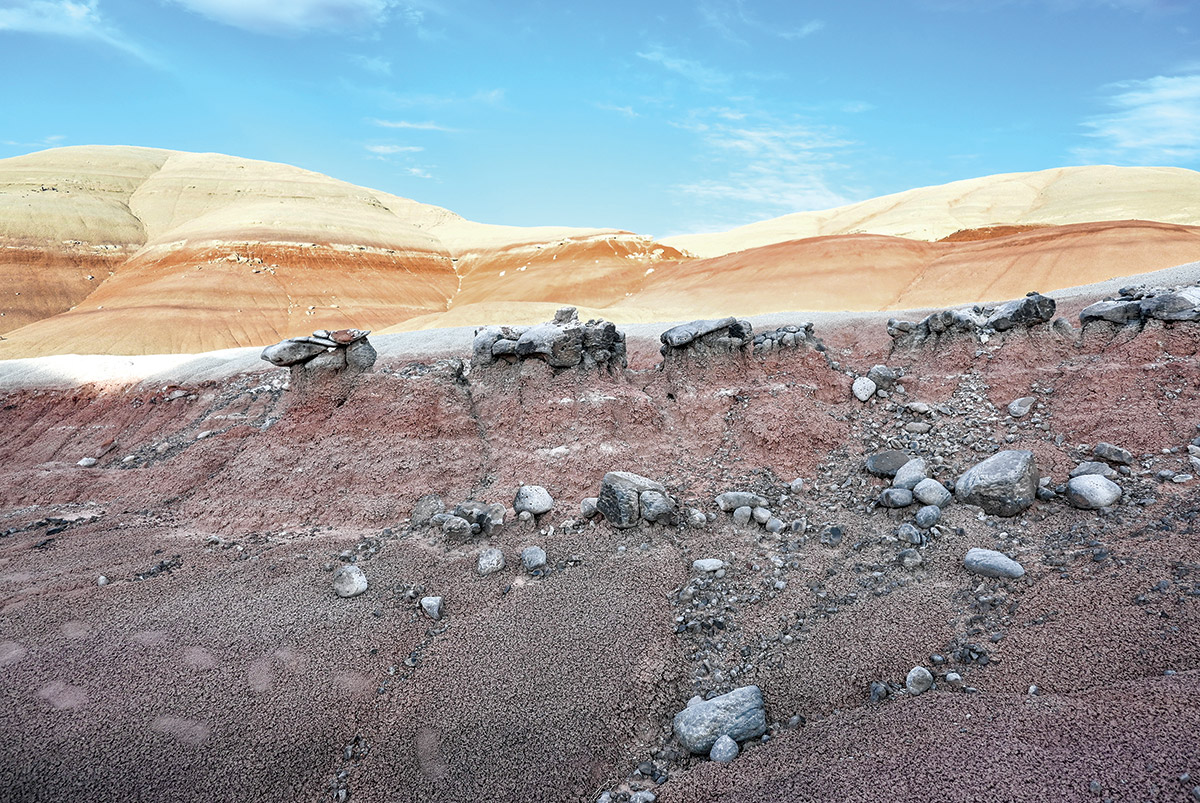
The Brushy Basin Member and close-up view of “popcorn” weathering. Shoe prints for scale.
The colorful layers in the Brush Basin indicate whether the sediments were exposed to either an oxidizing or reducing environment during their deposition. Red-, reddish-orange-, reddish-brown-, and purple-colored sediment contains iron oxide, usually hematite, which shows the sediments were deposited in oxygenated terrestrial environments like rivers, flood plains, and very shallow lakes. Green-, gray, and grayish-white-colored sediments were subjected to reducing (low oxygen) conditions indicating they were deposited in deeper lakes or had contact with or were submerged below the water table (groundwater) soon after deposition. The spectrum of colors in Brushy Basin strata reveal its dynamic depositional environment.
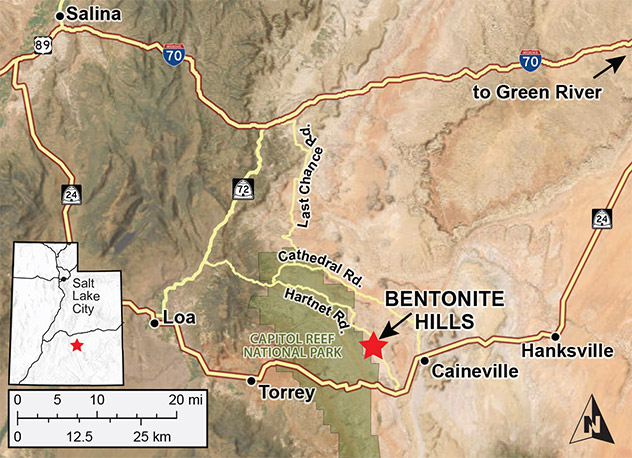
Bentonite Hills Location Map
How to Get There
Bentonite Hills is located along the Hartnet Road, which can be accessed from Interstate 70 or State Route (SR) 24 west of Hanksville, Utah. A high-clearance and/or four-wheel-drive vehicle is required to navigate the dirt road, which is impassable when wet, due to the swelling clay in the Brushy Basin Member. Also, if approaching from SR 24, the road crosses the Fremont River, which can be impassable if the river level is too high. Contact Capitol Reef National Park (435-425-3791) or visit their web page to inquire about conditions. Once in the area, stay on designated roads, limit foot traffic to previously disturbed areas, and please practice “leave no trace.”
Coordinates: 38.3603° N -111.1282° W