
Glen Canyon National Recreation Area
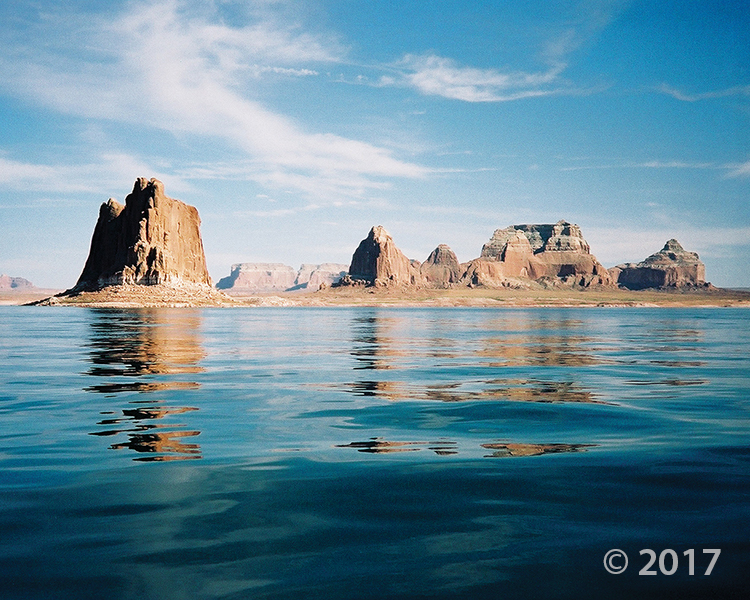
Photographer: Grant Willis © 2017
Padres Butte towers over Lake Powell’s Padre Bay, both named for the Dominguez-Escalante Expedition, which crossed the Colorado River near this site in 1776. Padres and the other buttes in this area are composed of Entrada Sandstone, one of several geologic formations that form the sandstone “slickrock” that typifies much of southern Utah’s landscape.
Tag Archive for: Glen Canyon National Recreation area
Hite Crossing vicinity, Glen Canyon National Recreation Area, Garfield and San Juan Counties, Utah
Photographer: Don DeBlieux; ©2011
Permian- and Triassic-age sedimentary rocks color the shorelines of dam-impounded Lake Powell near the confluence of the Colorado and Dirty Devil Rivers. Although the lake water has submerged numerous relicts of ancient animal (including human) and plant life, traces of prehistoric life can still be found along the lake shores and in some tributaries.
Bluffs of Entrada Sandstone above Wahweap Bay on Lake Powell, Kane County, Utah
Photographer: Lance Weaver
One of the most photographed geologic formations in Utah if not the world, the Entrada Sandstone is the featured rock unit of Arches National Park, Goblin Valley State Park, Kodachrome Basin State Park, and parts of Glen Canyon National Recreation Area. Variations in the Entrada’s appearance across the state are due to differences in internal structure and composition as well as external stresses.
Kodachrome Basin State Park, Kane County, Utah
Photographer: Carole McCalla
Sand pipe of Carmel Formation sediment intruded into the overlying Entrada Sandstone. One of the most photographed geologic formations in Utah if not the world, the Entrada Sandstone is the featured rock unit of Arches National Park, Goblin Valley State Park, Kodachrome Basin State Park, and parts of Glen Canyon National Recreation Area. Variations in the Entrada’s appearance across the state are due to differences in internal structure and composition as well as external stresses.