
What Utah mountain range honors prominent geoscientists of the 19th century and who were they?
By Carl Ege
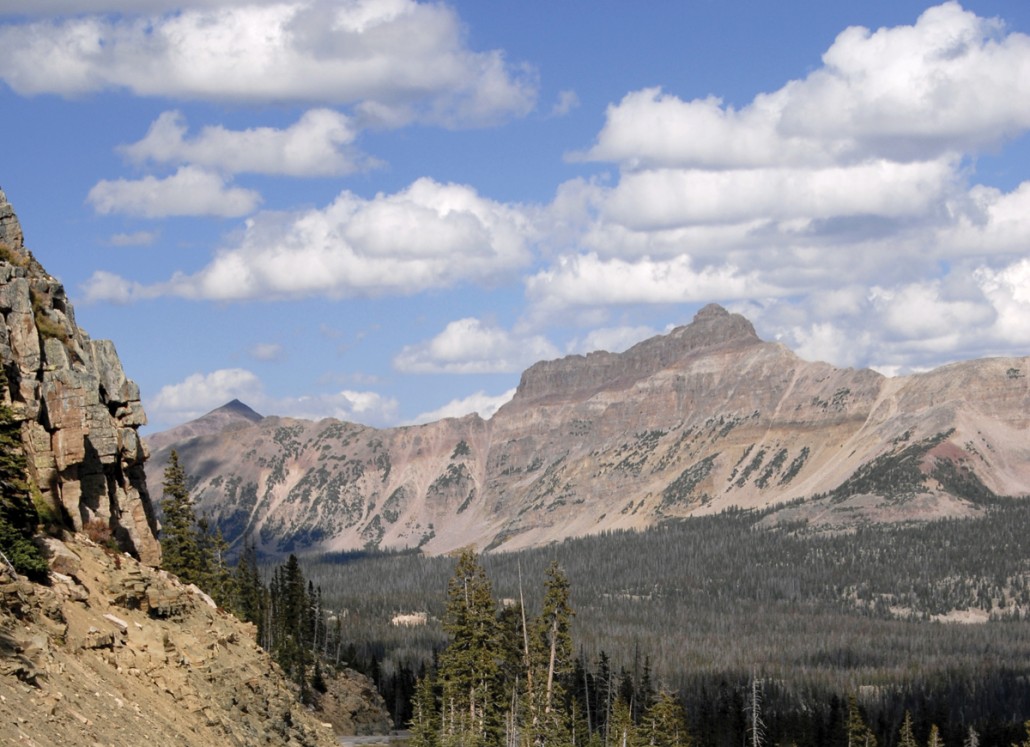

Many geographic features in Utah are named in honor of explorers, trappers, ranchers, and pioneers who were important to the state’s history.
However, there is one mountain range that commemorates early 19th century geologists and topographers who were influential figures in the geoscience field: the Uinta Mountains.
More than 20 major geographic features in this mountain range (lakes, streams, and mountain summits and passes) bear the names of these important geoscientists. Many of these early geoscientists developed the basic framework of the current understanding of geologic concepts we now study and practice.
Some of these geoscientists were also responsible for organizing and/or participating in the first scientific surveys for the United States government, exploring regions of Utah and throughout the American West.
Known as the four “Great Surveys,” the main objectives were to investigate, map, and study the natural resources and geology of the American West.
The first was the Geological Survey of the 40th Parallel led by Clarence King from 1867 to 1878. The survey was successful in mapping the topography and geology in the Sierra Nevada, Great Basin, Uinta Mountains, and Rocky Mountains along the latitude of 40 degrees north.
This was closely followed by Ferdinand Hayden’s survey (known as the Geological and Geographical Survey of the Territories) of Nebraska, Utah, Wyoming (Yellowstone area and Teton Range), Colorado, and Idaho from 1867 to 1879; John Wesley Powell’s survey (known as the Geographical and Geological Survey of the Rocky Mountain Region) of the Green and Colorado Rivers and through the Grand Canyon from 1869 to 1879; and George Wheeler’s survey of the U.S. territory west of the 100th meridian (Nevada, Utah, California, Arizona, Idaho, and New Mexico) from 1871 to 1879. (Just across Utah’s border, the second-highest peak in Nevada is named after Wheeler.)
All these government surveys were important in providing geologic information that helped “open up” the American West to frontier settlement and led to preserving geological areas, such as Yellowstone National Park, for future generations.
Three of the four “Great Surveys” (King’s, Hayden’s, and Powell’s) investigated the Uinta Mountains region, and these geoscientists were responsible for naming the newly discovered geographic features in the Uinta Mountains.
The following table lists the Uinta Mountains’ geographic features named for geoscientists.
| Geographic feature | Geoscientist | Who were these geoscientists? |
|---|---|---|
|
Atwood Creek and Atwood Lake |
Wallace Atwood |
Geologist who studied glaciation in Uinta Mountains. |
|
Gatman Lake |
Gatman |
Geologist and naturalist. |
|
Gilbert Peak, Gilbert Creek, and Gilbert Lake |
Grove K. Gilbert |
Geologist who did pioneering research on Lake Bonneville, Great Salt Lake, and the Henry Mountains. |
|
Hayden Peak, Hayden Pass, Hayden Fork, and Hayden Lake |
Ferdinand Hayden |
Geologist for early government surveys. Visited Uinta Mountains in 1870. |
|
Hyatt Lake |
Alpheus Hyatt |
Naturalist, zoologist, and paleontologist. |
|
Kings Peak, Kings Lake,and South Kings Peak |
Clarence King |
Conducted Geological Survey of the 40th Parallel. First director of the U.S. Geological Survey. |
|
Leconte Lake |
Joseph Leconte |
Geologist and educator who worked with John Muir. |
|
Leidy Peak |
Joseph Leidy |
Paleontologist who studied the Bridger and Uinta Formations. Considered father of vertebrate paleontology. |
|
Marsh Lake and Marsh Peak |
Othniel Marsh |
Paleontologist who studied the Bridger Formation. |
|
Mount Agassiz |
Louis Agassiz |
Professor of Zoology and Geology at Harvard University. |
|
Mount Emmons |
Samuel Emmons |
Geologist for the Geological Survey of the 40th Parallel. |
| Mount Powell and Powell Lake | John Wesley Powell | Led surveys down the Colorado and Green Rivers. Second director of the U.S. Geological Survey. |
|
Packard Lake |
Alpheus Packard |
Professor of Biology and Geology at Bowdoin College. |
|
Scudder Lake |
Samuel Scudder |
Paleontologist who is considered the father of insect paleontology. |
|
Shaler Lake |
Nathaniel Shaler |
Professor of Paleontology and Geology at Harvard University. |
|
Walcott Lake |
Charles Walcott |
Geologist and paleontologist who studied the Burgess Shale. Third director of the U.S. Geological Survey. |
|
Wilson Peak |
A.D. Wilson |
Head topographer for the Geological Survey of the 40th Parallel. |
|
Verrill Lake |
Addison Verill |
Geologist and zoologist. |
The Great Surveys of the American West
1.Clarence King, Geological Survey of the 40th Parallel, 1867 to 1878
2. Ferdinand Hayden, Geological and Geographical Survey of the Territories, 1867 to 1879
3. John Wesley Powell, Geographical and Geological Survey of the Rocky Mountain Region, 1869 to 1879
4. George Wheeler, US Geographical Surveys West of the 100th Meridian, 1871 to 1879
Survey Notes, v. 37 no. 3, September 2005
