
Why does the eastern border of Utah have a kink in it?
By William F. Case
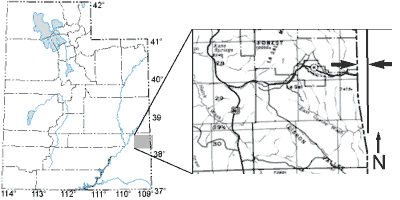
Utah’s present boundaries are much different than the original “state” of Deseret boundaries proposed by Mormon church leaders in 1849. Deseret included pieces of today’s Utah, Nevada, California, Arizona, New Mexico, Colorado, Wyoming, Idaho, and Oregon.
When the “state” of Deseret became the official Utah Territory in 1850, it was compressed between latitudes 37°N and 42°N, and between California and the Territory of Colorado. From 1861 to 1868 pieces of the Utah Territory were parceled out to adjoining territories. An eastern piece went to Colorado, three western slices became Nevada, and Utah’s northeastern “notch” went to the Wyoming and Idaho (yes, Idaho) Territories.
Utah’s boundaries are not defined by landforms such as mountain divides or rivers. Surveyors mapped Utah’s boundaries using transit and compass, chronometer and astronomical readings, previous surveys, and interviews with residents. The boundaries were intended to run parallel to lines of latitude and longitude.
So, why the westward jog of more than one mile? In 1879 a survey to establish the western border of Colorado started at Four Corners, the only place in the USA where four states share a point, and continued on a true-north line to the southern border of Wyoming. The survey continued north about 276 miles to the Wyoming border but ended about one mile west of where they expected to intersect the Wyoming line; somewhere there was a westward jog in the border.
An 1885 survey found an error of slightly over one mile between mileposts 81and 89 (81 and 89 miles north of Four Corners), and an 1893 survey by the U.S. Coast and Geodetic Survey found a half-mile error between mileposts 100 and 110.
Why didn’t the surveyors change the boundary when they found errors? Once a boundary is marked on the ground and accepted by all interested parties it is a true line even though it doesn’t follow the written description.
A boundary between two states may be changed by agreement of the state legislatures and must be approved by Congress. The Colorado/Utah border stands as surveyed!
For further information consult the Atlas of Utah by D.C. Greer, 1981, Weber State College and Brigham Young University Press, or J.O. Johnson’s State of Deseret, 1992, from Macmillan Publishing Company, Encyclopedia of Mormonism, v. 1.
And there is F.K. Van Zandt’s 1966 Boundaries of the United States and the several states published by the U.S. Geological Survey as Bulletin 1212.
Survey Notes, v. 32 no. 3, October 2000
